You can fix anything later, except modularity
Good modularity lets you tolerate crummy code locally and fix it later without breaking everything.
Good modularity lets you tolerate crummy code locally and fix it later without breaking everything.
High-quality software is well-designed software before it is well-built software. Let’s take a look at how to get there.
Measure an outcome rather than an output. This way, you empower your teams and align them with your company’s goals.
The problem is that the benchmark (Waterfall) leads to software that doesn’t meet users’ needs…
Don’t ask, “How long will this take?” Instead, ask yourself if you can break your work down into even smaller pieces.
Moving fast is easy. Maintaining that pace for years is more difficult and is the true mark of software quality.
Producing high-quality software involves organizational aspects that go beyond technology and can undermine the CTO’s efforts.
A lack of modularity is costly. Investing in a modular architecture protects your software and prevents massive financial losses.
It’s easy to blame developers. But bugs also stem from design, organization, and culture.
Here are a few pieces of advice, drawn from my experience working with companies, that I wish I’d had back when I was a manager.
The road to hell is paved with good intentions, and your Quality Department is no exception: it’s impossible to distinguish between “doing” and “doing better.”
Co-creating your product with your first customers is a good thing. However, that doesn’t mean giving in to all their requests.
Sequential methodologies do not work for business software, primarily because of tunnel vision. Is there an alternative? Agile.
This phrase, a DevOps mantra, is rooted in common sense. Yet the organization sometimes resists its implementation. CEOs, lay the groundwork.
Separating the IT function from the business units it serves is a fundamental mistake, because IT is viewed solely through the lens of its cost.
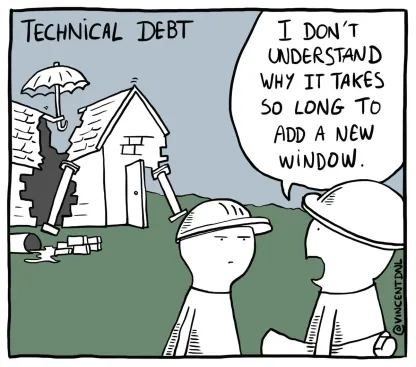
Developing quickly without the right skills invariably leads to the accumulation of technical debt. Invest in it now: it will cost you less in the long run.
Now, let’s hear from one of my clients, Ovrsea. Antoine, the CTO, explains how the idea to bring in coaching for his teams came about and what it has changed.
Technical debt is dangerous because it accumulates silently, until the day the company hits a wall. CEOs, take the lead.
Writing code isn’t that hard; evolving it is. Readability, testability, modularity: the three pillars of software craftsmanship.