The Obsession with Customer Service
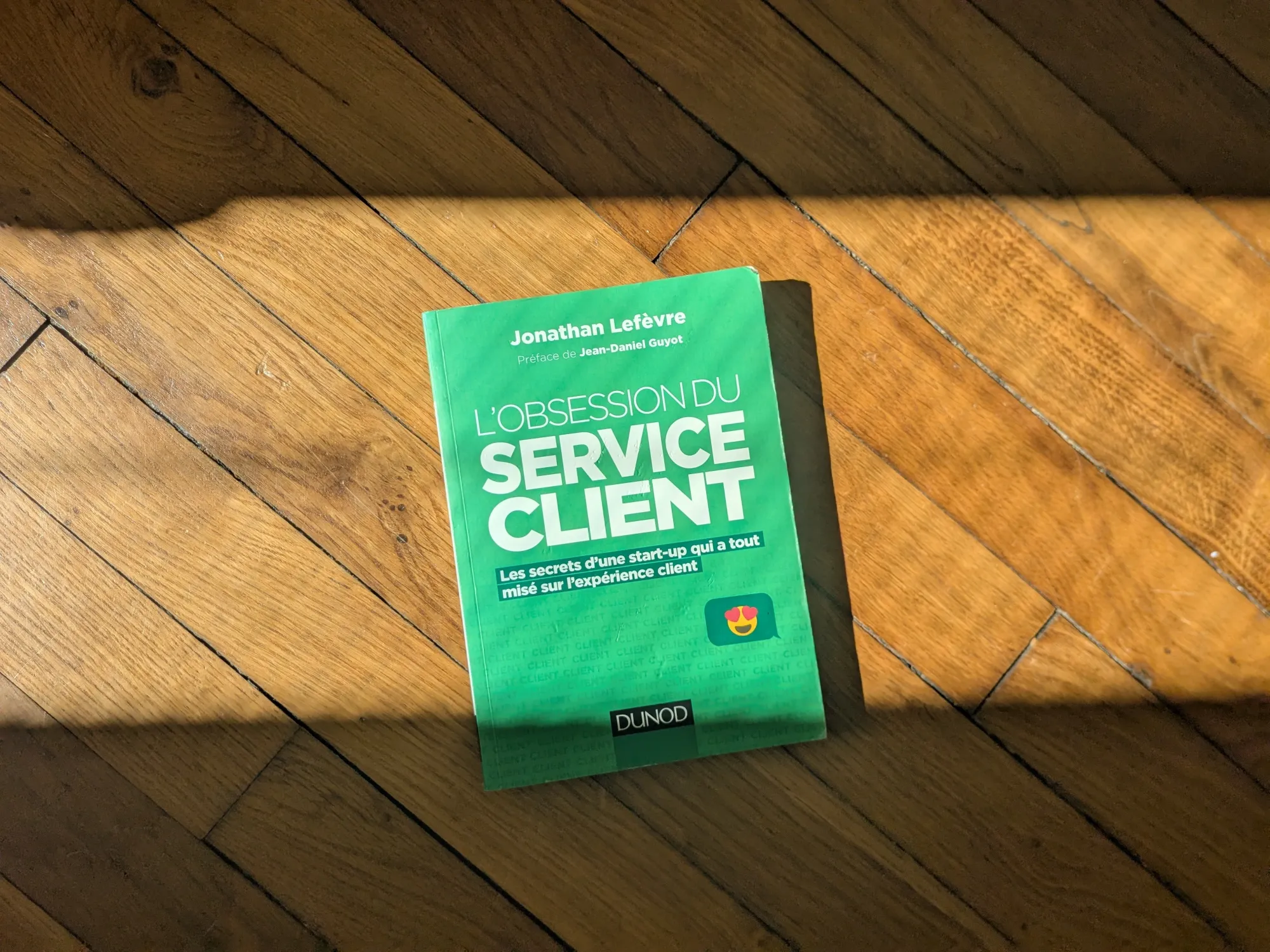
You really can find everything in book boxes: everything from Pascal Sevran’s memoirs to the Thermomix TM 3000 user manual, including occasional gems such as The Obsession with Customer Service by Jonathan Lefèvre, published by Dunod.
To be honest, I might not have bought this book in a bookstore. I’d already read a few articles on customer care, but I had no idea there was enough material to fill 250 pages on the subject. And that’s exactly the appeal of book subscription services: trying them out costs nothing. So I decided to give it a shot.
It was a good decision, because this book immediately earned a place in my personal pantheon of works useful to my work. The insightfulness of the argument is such that I am dedicating this article to it, in the form of a subjective and non-exhaustive book review.
In this book, Jonathan Lefèvre recounts his experience and what he helped create at Capitaine Train (now known as Trainline), where he was one of the first employees. The company was founded in 2009 when the train ticket market was opened up to competition and positioned itself as a break from Voyages SNCF, which had improperly held a monopoly on the market.
A company can set itself apart through its customer service
Capitaine Train didn’t run the trains, Capitaine Train didn’t offer better prices (to my knowledge), but Capitaine Train had decided to address the frustration of the “users” of the Voyages SNCF website. A redesign has come and gone, nothing has changed, and there’s still plenty to question his sanity when you venture to book a train ticket via SNCF Connect. Capitaine Train is thus proof that you can start a company whose sole purpose—and whose entire added value—lies in customer service, while at the same time making significant savings on the marketing budget. I’ll let you read the book to find out more—it goes into great depth.
One question, however, quickly comes to mind: how can you maintain the same level of customer care as the company grows?
Everyone on Support
Organization is part of the answer. In addition to good software, you need good customer support. But Customer Support can’t be an isolated team tasked with making up for the software’s shortcomings or glitches. So Capitaine Train has turned this function into a shared responsibility: there is indeed a Support team, but the entire company is subscribed to and actively contributes to the support Slack channel, and everyone dedicates half a day per month to it. There’s nothing better for fostering empathy—so essential for product managers and developers—and helping them understand the consequences of their actions. At its core, it’s an extension of the “you build it, you run it” so dear to Amazon.
A Back Office with Attention to Detail
Providing effective customer support requires a robust, feature-rich back office. The tool must be an extension of the mind. Capitaine Train has therefore chosen to treat internal users—its employees—with the same care as its external users. Naturally, this is an investment. In practice, this means having developers dedicated to the back office—which shouldn’t surprise us, as advocates of strategic Domain-Driven Design, because a back office typically constitutes a bounded context in its own right.
Recruitment Shapes a Company’s Culture
Such dedication to the client requires a strong corporate culture—that is, clearly defined values. But a person’s values are unlikely to change through the work of the Holy Spirit. You must therefore recruit people who share these same values—people for whom your culture is second nature. Otherwise, you’ll waste your time trying to change what cannot be changed (as a coach and consultant, this is actually a real topic for reflection). One point to keep in mind, however: only hire as a last resort, after exhausting all avenues for organizational and technical improvement. Because adding more people is an easy way out that doesn’t solve the underlying problems.
Conclusion
This is, in short, an illuminating book, from the first page to the last. The final chapter, “Managing Through Trust,” goes far beyond the book’s main subject and could serve as a management manifesto without changing a single comma.
If, however, there’s one thing missing from this book, it’s undoubtedly any mention of the connection to Lean Management, which seems to me to underpin the entire discussion. Continuous improvement for the benefit of the customer, the need to break down silos—isn’t that exactly what this book is about?