Rest In Peace
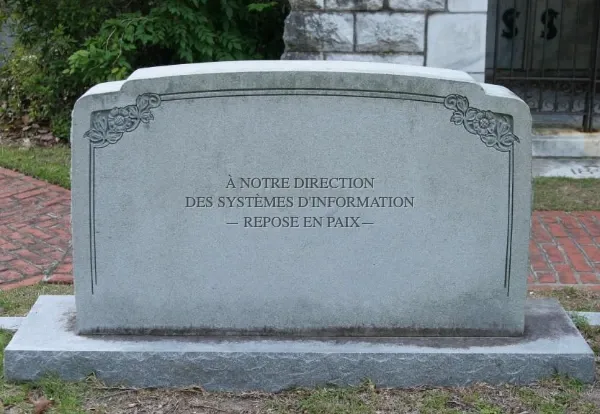
I toiled away for nearly 15 years at very large companies—those listed on the CAC 40. It all began in the late 2000s, and it had all the hallmarks of an “IT department” (Information Systems Department).
I experienced all the hardships firsthand, starting with a very palpable mistrust between the IT department and the departments it was supposed to serve: human resources, finance, and various business units within these companies.
The IT Department: A Cost Center
In practical terms, I spent my days getting criticized because things weren’t moving fast enough, were too expensive, or didn’t work as planned. I myself was the first to be dissatisfied with the quality of the service provided.
I’ve often wondered about my share of the responsibility during those years, and naturally, I bore some of it. Starting with the tendency to withdraw into myself and the ease with which I and my IT colleagues would agree that those darn clients didn’t understand a thing.
Yet all this mediocrity (let’s call a spade a spade) had, above all, a structural cause: the fact that IT was viewed as a cost, without measuring and comparing it to the profits generated at the corporate level.
What were the consequences?
Optimizing the IT department means reducing its costs
You can only optimize what you measure. If the only metric for a system is its cost, the only way to improve the system is to reduce that cost. This, in fact, is the core issue with “support functions” (finance, HR, etc.) and the cost-driven culture that goes along with them.
Except that when it came time to set budgets—since trust was lacking—the business stakeholders would ask the IT department to commit to all three factors: scope, costs, and deadlines. Zero room to maneuver.
It’s hard to imagine the finance department saying, “Well, let’s put three developers on it and see what we can do in a year—we’ll just take an iterative approach anyway,” even though that would be the only rational thing to do.
As a result, the organization inevitably resorted to waterfall methodologies, a rejection of agility, and risky gambles such as attempting to cover the same scope with a budget cut by 15% right from the start…
What alternatives are there?
If we unravel this thread, it is the very existence of CIOs that must be called into question. Since IT tools generate only secondary value (they improve the company’s efficiency), measuring profit will always remain difficult and artificial. Unable to quantify this additional profit, CIOs will remain perpetual cost centers.
Fortunately, other organizations have since emerged, generally based on the following model:
-
Teams of a few developers fully integrated into the business—that is, working in the same offices and fully integrated into the budget;
-
Cross-functional technical coordination, led by a small Technical Department, aimed at fostering healthy competition among developers and promoting knowledge sharing.